
In recent times, I have coached a number of clients in Ireland who have been tasked with preparing and delivering a “presentation” at their final round interview. These clients include candidates seeking promotion to roles such as HEO, Assistant Principal Officer and Superintendent, amongst others.
For many clients, this can feel like the most daunting part of the process; however, it is also a fantastic opportunity to demonstrate your knowledge, judgement, communication skills and readiness for promotion.
You can control this element of the interview assessment and, therefore, with careful preparation and practice, there is an excellent opportunity to score highly and impress the interview panel.
For these “presentation” type exercises, there is usually a strict time limit of 5, 10 or 15 minutes, followed by questions from the Interview Board. Every minute needs to count.
Here are six tips to help candidates deliver a high performance “presentation”:
1. Pitch your message at the level of the role you are seeking
Make sure your key messages reflect the level of the role or promotion you are seeking. Remember, you are not being assessed in your current or previous role. You are being considered by the Interview Board for an elevated role, shaped by predetermined competencies, capabilities, attributes and skills.
Your “presentation” must therefore demonstrate the thinking, judgement, leadership and strategic awareness expected at that level. Ask yourself: What would someone operating successfully at this level understand, prioritise and recommend?
2. Structure is key!
Have a clear beginning, middle and end. Introduce your purpose, develop your key points in a logical sequence and finish with a strong conclusion. Make it easy for the Interview Board to follow your thinking. Ensure each point supports your central message and links clearly to the competencies, capabilities or skills being assessed.
3. Get your “introduction” right
How will you grab the Interview Board’s attention? Open with a relevant question, a compelling fact or a clear statement of the challenge. Establish early why your approach matters and why it is relevant at the level of the role you are now seeking.
4. If possible, consider standing up!
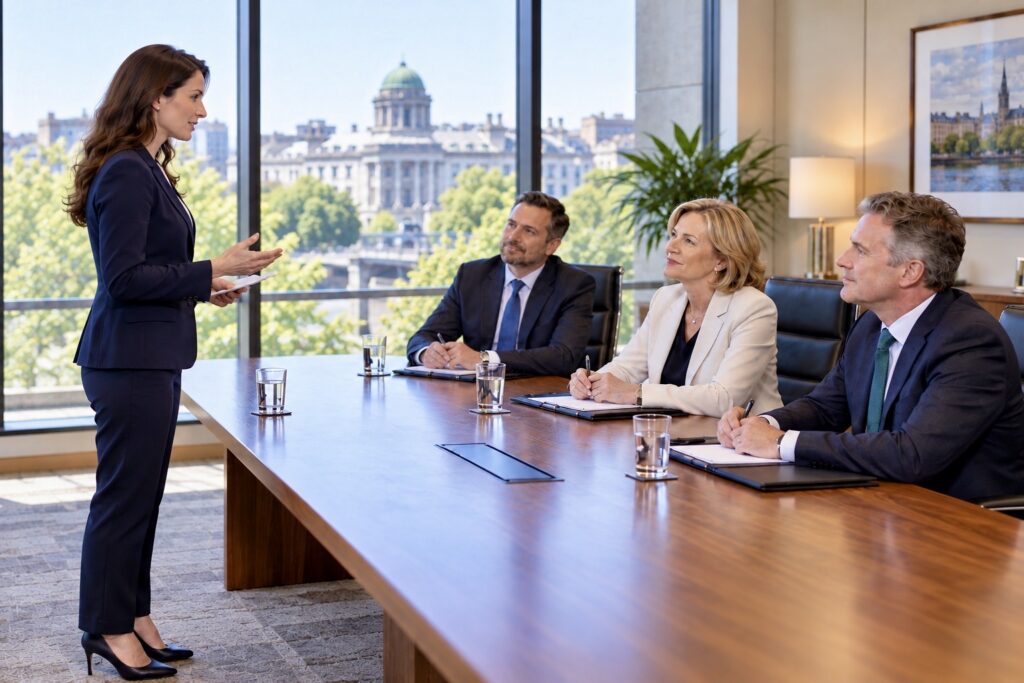
Where the format allows, consider delivering your “presentation” standing up. This can help with posture, breathing, voice projection and presence. Practise standing beforehand so that it feels natural and comfortable on the day.
Many candidates simply go with the flow and deliver their “presentation” sitting down, but I know from experience that diplomatically asking the Interview Board if you can stand for this element of the assessment can send a strong, positive message. It can also help distinguish the presentation element from the traditional competency / capability element of the interview.
Whether standing or sitting, make sure that you maintain eye contact with all board members. Your aim is to positively engage them in what you are saying from the start to the finish.
5. Record it. Time it. Refine it.
Before the big day, record yourself delivering the “presentation” aloud. Check your pace, clarity and timing. Aim to finish within the time limit, allowing room for pauses.
Trial a mechanism to help you remember your key points. Cue cards can be very effective, but use only key “crutch words” to prompt your memory. A quick glance should be enough, you should not be reading from them.
If you have prepared a PowerPoint, check that it is permitted and have a Plan B in case you cannot use it or the technology fails on the day, so make sure you practise delivering without your slides.
6. Make an impact!
What will the board remember about your “presentation” after you have left the room? Identify the central message you want them to take away. A relevant example, a clear recommendation or a thoughtful insight can help your “presentation” stand out from all the other candidates.
Show that you can think and communicate at the level you are seeking. Avoid simply describing what you have done in the past. Explain the wider implications, the positive outcomes achieved and how your experience demonstrates readiness for the next level.
Finally, prepare for questions, be ready to explain your reasoning, defend your recommendations and discuss how your proposals would work in operational practice.
Final thoughts
For Interview Boards, “presentations” provide a great insight into a candidate’s communication, interpersonal and strategic thinking.
For Candidates, it’s a great opportunity to impress, but it needs planning, preparation and practice!
If you want to get “Interview Ready”, check out www.featherstone.ie